Thriving (not just surviving) in SLP Graduate School

We’re so excited about the next post in our new collaborative expert series #slpwithme! Sam Walker of Speaking of Samantics has partnered with us to share some helpful tips on thriving (not just surviving) in SLP graduate school.
Thriving (not just surviving) in SLP Graduate School
The SLP grad school experience is a complex journey. You will dive deep into complicated topics while honing your clinical skills across an incredibly wide scope of practice. You will have to navigate feedback from supervisors that can range from positive to critical. You will likely experience a mix of emotions—overwhelm, anxiety, uncertainty, and a bit of imposter syndrome—alongside excitement, curiosity, and pride for all you have accomplished.
It’s a lot! You may often feel like you are just surviving. But, nobody wants to just survive! This experience is the foundation for your lifelong career.
Here are some tips for making your graduate school experience as an SLP a positive one, from a few seasoned SLPs (@speakingofsamantics and the SLPs at @littlebeespeech). Because you deserve to thrive, not just survive, SLP grad school!

Tip 1: Find Your People
Entering your grad program without familiar faces by your side can feel daunting. Take this opportunity to get to know your classmates and build relationships with those you connect with. It’s okay if it doesn’t happen right away- building relationships takes time, but it’s well worth the effort. Strong relationships with classmates will not only benefit your academic success through study groups, collaboration, and material sharing, but the friendships you form will be monumental to your ability to thrive in both grad school and in your future career.

Tip 2: Understand What Type of Learner You Are
Everyone learns differently. It is easy to get down on yourself if a traditional teaching style or your professor’s teaching style does not align with how you learn. Take some time to figure out what type of learner you are to maximize your graduate school experience.
Consider the following:
• How do you enjoy learning new information?
• What helps you retain information?
• Do you benefit from reviewing notes or drawing pictures?
• Does summarizing what you have learned or making flashcards help you?
Chelsea from Little Bee Speech shares:
“I found that I really needed to take notes in class and/or follow along with PowerPoints. Audio-only information was difficult for me to retain. I learned a lot through rewriting notes from classes and making them into flashcards. Just the process of writing things down helped me remember more. I also discovered that discussing things with others helped me retain information once I had some base knowledge.”
Sam from Speaking of Samantics says:
“I put myself down test grade after test grade, not realizing that I wasn’t supporting my own learning. I am a multimodal learner through and through. I need pictures, videos, text, and summarizing. When I started doing those things for myself, I realized things were clicking so much easier. Give yourself the opportunity to learn in the best way for you. Watch YouTube videos of muscles. Create study sheets with pictures. Use a whiteboard or an iPad to doodle your own drawings.”

For a fun and flexible way to prep for the Praxis when your graduate school experience ends, check out Sam’s game-based test prep company, SLP Test Prep. She’s created a study method that caters to all learning modalities!

Tip 3: It’s Okay if You Don’t Know—Ask Questions and Ask for Help
No one expects you to know everything! Your qualifications and dedication have brought you to this program, but there is so much to learn, and you can’t possibly know it all. Don’t be afraid to ask questions, get clarification, or ask for help. It’s okay to reach out to your professor after class if you don’t understand a topic. It’s okay to ask what your clinical supervisor thinks of the strategies you used in your therapy session. This is the time to ask those questions, and they are always welcome.

Tip 4: Utilize the Little Bee Hive University Program from Little Bee Speech
Reliable tools for assessments and therapy can make or break your clinical experience. Thankfully, there’s a FREE tool that every SLP graduate student can access throughout their graduate school experience—the Little Bee Hive University Program!
The Little Bee Hive University Program provides university clinic supervisors and SLP graduate students free access to the Little Bee Hive Membership, which includes both Articulation Test Center Hive and Articulation Station Hive, comprehensive tools for the assessment and treatment of speech sound disorders.
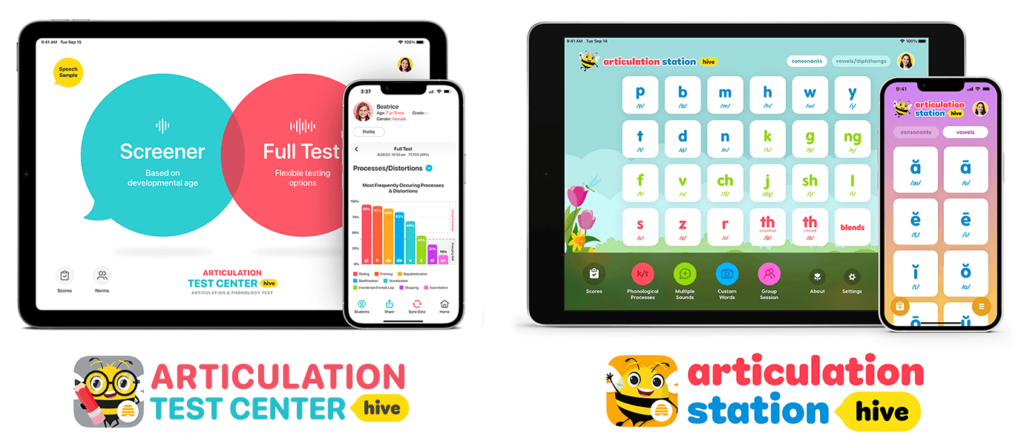
Articulation Test Center Hive features:
• Stimulus cards with real images
• Interactive speech sample scenes
• Assessment of consonants and vowels
• Auto-marking for phonological processes
• Detailed error and process analysis
• Auto-generated reports and more!
Articulation Station Hive features:
• Interactive and animated speech sound cues
• Syllable sliders and spinners
• Minimal pairs
• Matching games
• Flashcards
• Rotating phrases and sentences
• Sound-saturated sentences and stories
• Interactive Conversation scenes and more!
To get your graduate program signed up with the University Pilot Program, have a verified clinical supervisor or university professor from your university complete this form.

Tip 5: Purchase Cloud-Based Storage
This will be incredibly helpful while you are in school and throughout your career! When purchasing cloud-based storage, use your personal email (since school emails disappear after graduation).
There are many options when it comes to cloud-based storage. Some solid, popular options include:
• Google Drive (Windows, Mac, iOS, Android, Web) Learn more
• iCloud (Mac, Windows, iOS, Web) Learn more
• Dropbox (Mac, Windows, iOS, Android, Web) Learn more
Do a little research on what will work best for you and go with it.
In your cloud-based storage create two main folders:
1. Clinic
2. Class
Within those main folders, make subfolders for topics like:
• articulation
• phonology
• executive function
• research, etc.
This will help you keep everything organized and build a toolbox of resources.
Remember, SLP graduate school is about more than just surviving—it is about growing and learning. Keep a positive perspective, find your people, understand how you learn best, take advantage of tools and resources, and stay organized. You are stronger and more capable than you realize. Trust the process, take it one step at a time, and soon you will be amazed at how far you have come.
You’ve got this!

About Sam: Sam is the spirited and passionate owner of Speaking of Samantics and the SLP Test Prep. She has a passion for her creative and unique designs with stickers, t-shirts and much more! Sam has embraced her role as a fervent advocate for graduate students in the field of speech pathology. Recognizing the challenges of graduate school, she is determined to reshape the narrative, striving to create a more accepting and supportive environment for all those navigating this demanding journey.
